2020

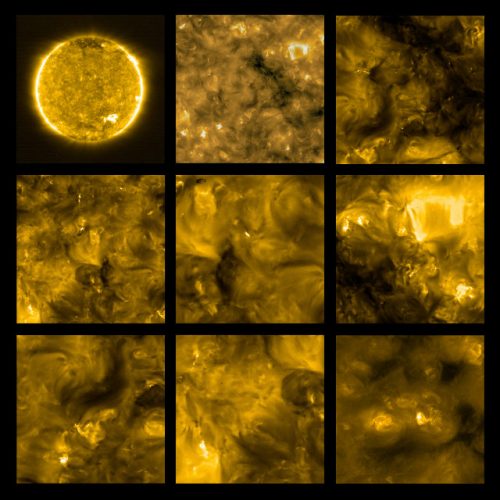
The Sun and its campfires seen by Solar Orbiter

ESA and NASA have published images captured by the Solar Orbiter space probe during its first Sun flyby. In this case, flying by means at a distance of about 77 million kilometers (48 million miles). During that maneuver, all its instruments were active after they were tested and commissioned despite the problems resulting from the Covid-19 pandemic with the difficulties for mission engineers and scientists. Among the first images, there are the ones of the so-called campfires, eruptions that are small by solar standards but are larger than many Earth nations.

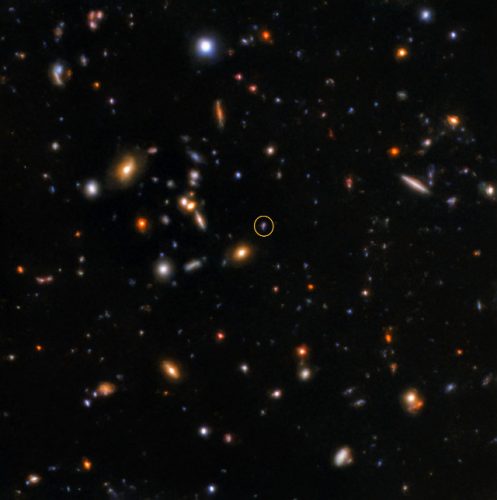
The afterglow of GRB181123B seen by Gemini North (Image courtesy International Gemini Observatory/NOIRLab/NSF/AURA/K. Paterson & W. Fong (Northwestern University))

An article to be published in “The Astrophysical Journal Letters” reports a study of the short gamma-ray burst cataloged as GRB181123B focusing on the discovery of what in jargon is called afterglow, in short, the residues of the emissions of GRB181123B, which in this case were detected at optical frequencies as well. The estimates indicate that that event was generated around ten billion years ago making it the most distant ever detected with an optical afterglow. Probably the cause was a neutron star merger, so events of this type offer information on how long it took for them to occur and their amount at that time.

WISEA J181006.18-101000.5

An article published in “The Astrophysical Journal” reports the discovery of two brown dwarfs thanks to the help of citizen scientists who participated in the Backyard Worlds: Planet 9 program. Cataloged as WISEA J041451.67-585456.7 and WISEA J181006.18-101000.5, those are two objects with masses that fall within the range typical of brown dwarfs but with other characteristics more similar to those of gas giant planets. They could be the first extreme T-type subdwarfs, and resemble ancient exoplanets, with very little iron, having an estimated age of around 10 billion years. Their characteristics make them useful to better understand exoplanets.

Jezero Crater on Mars

Two articles published in the journal “Icarus” report as many studies on Jezero Crater on Mars. Two teams of researchers used data collected by ESA’s Mars Express space probe to reconstruct various parts of the history of Jezero Crater which, with its approximately 49 kilometers in diameter, in the past used to host a lake. It dried out long ago, but left traces such as clay materials that only form in the presence of water. The diversity of minerals is also due to an ancient volcanic activity that affected the entire region. NASA’s Mars 2020 mission, with the Mars Rover Perseverance, will land in Jezero Crater, if all goes well, in February 2021 to also look for possible traces of life, present or past.

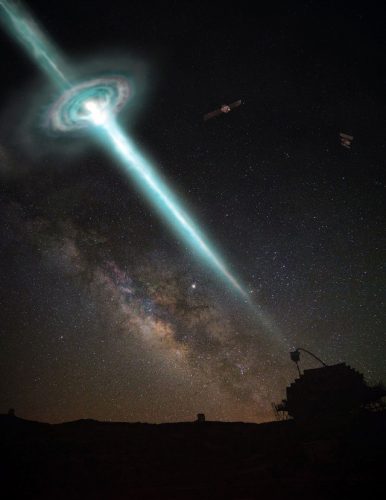
Artist's concept of gamma-ray burst (Image courtesy Superbossa.com e Alice Donini)

An article published in the journal “Physical Review Letters” reports a measurement of the invariance of the speed of light in vacuum at different energies thanks to observations of the gamma-ray burst cataloged as GRB 190114C, the most powerful ever observed. The scientists from the MAGIC Collaboration used the data collected by the two MAGIC telescopes in the Canaries to investigate in particular a phenomenon called Lorentz invariance violation (LIV), ending up with yet another confirmation of Albert Einstein’s theory of general relativity.