Massimo Luciani

WISEA J181006.18-101000.5

An article published in “The Astrophysical Journal” reports the discovery of two brown dwarfs thanks to the help of citizen scientists who participated in the Backyard Worlds: Planet 9 program. Cataloged as WISEA J041451.67-585456.7 and WISEA J181006.18-101000.5, those are two objects with masses that fall within the range typical of brown dwarfs but with other characteristics more similar to those of gas giant planets. They could be the first extreme T-type subdwarfs, and resemble ancient exoplanets, with very little iron, having an estimated age of around 10 billion years. Their characteristics make them useful to better understand exoplanets.

Jezero Crater on Mars

Two articles published in the journal “Icarus” report as many studies on Jezero Crater on Mars. Two teams of researchers used data collected by ESA’s Mars Express space probe to reconstruct various parts of the history of Jezero Crater which, with its approximately 49 kilometers in diameter, in the past used to host a lake. It dried out long ago, but left traces such as clay materials that only form in the presence of water. The diversity of minerals is also due to an ancient volcanic activity that affected the entire region. NASA’s Mars 2020 mission, with the Mars Rover Perseverance, will land in Jezero Crater, if all goes well, in February 2021 to also look for possible traces of life, present or past.

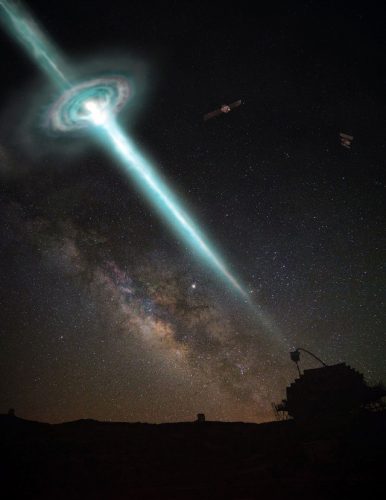
Artist's concept of gamma-ray burst (Image courtesy Superbossa.com e Alice Donini)

An article published in the journal “Physical Review Letters” reports a measurement of the invariance of the speed of light in vacuum at different energies thanks to observations of the gamma-ray burst cataloged as GRB 190114C, the most powerful ever observed. The scientists from the MAGIC Collaboration used the data collected by the two MAGIC telescopes in the Canaries to investigate in particular a phenomenon called Lorentz invariance violation (LIV), ending up with yet another confirmation of Albert Einstein’s theory of general relativity.

Rho Ophiuchi cloud complex viewed by Herschel and Planck (Image ESA/Herschel/Planck; J. D. Soler, MPIA)

An article published in the journal “Astronomy & Astrophysics” reports a study of the magnetic fields of molecular clouds to understand their influence in the processes that lead to star formation. Astronomer Juan D. Soler of the Max Planck Institute for Astronomy in Heidelberg, Germany, used data collected by the Planck Surveyor space probe during its mission and the Herschel space telescope during the Gould Belt Survey to investigate the characteristics of the interstellar medium and especially molecular clouds. The study was published in 2019, but more spectacular images have been published by ESA of combined views of molecular clouds.

Illustration of the shock fron in the Eta Carinae system (Image courtesy DESY, Science Communication Lab)

An article published in the journal “Astronomy & Astrophysics” reports the detection of extremely energetic gamma-ray emissions from the Eta Carinae system. A team of researchers coordinated by the German national nuclear physics research center DESY used the HESS telescope system to detect those gamma rays and prove that they were generated by the collision of stellar winds from the two blue giant stars that make up this binary system. Various models have been proposed, and a study published in a second article on “Astronomy & Astrophysics” offers some evaluations that follow a reanalysis of data collected over time by various instruments.