Massimo Luciani

The L-1011 Stargazer aircraft taking off with the ICON satellite (Photo NASA/Frank Michaux)

A few hours ago the ICON (Interface Region Imaging Spectrograph) satellite was launched using a Pegasus XL rocket by Northrop Grumman brought to an altitude of about 11,900 meters by an L-1011 airplane, also by Northrop Grumman, modified for this purpose. After a little more than 11 minutes, ICON was brought into a low Earth orbit at an altitude of about 575 kilometers, where the solar panels regularly deployed and sent the first signals.

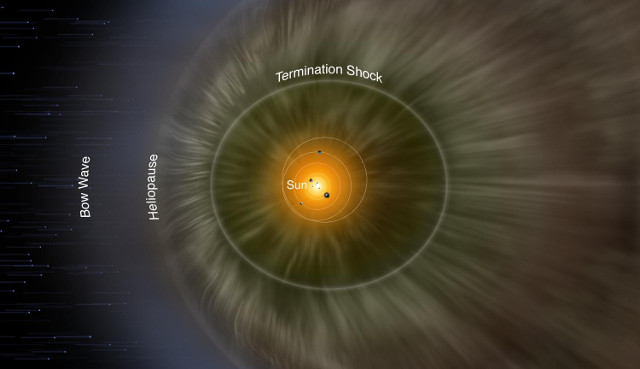
Illustration of the heliosphere (Image NASA/IBEX/Adler Planetarium)

A team of scientists led by Jamie Rankin of Princeton used measurements of the galactic cosmic rays detected by NASA’s Voyager space probes to obtain an estimate of the total pressure that plasma, magnetic fields and various particles exert on each other in the heliosheath, the outer region of the heliosphere, the big bubble around the Sun where solar wind exerts its influence. The result is higher than expected and will help to better understand the interactions between the Sun and its surroundings.

Traces of ancient salty ponds at the bottom of Gale Crater on Mars

An article published in the journal “Nature Geoscience” reports the results of an analysis of data collected by the Mars Rover Curiosity in a section of sedimentary rocks of Gale Crater on Mars called Sutton Island where salt was detected in the form of mineral salt in the sediments. A team of researchers led by William Rapin of Caltech interpreted that presence as evidence that about 3.5 billion years ago there were salty ponds that went through episodes of overflow and drying. The deposits show the history of climatic fluctuations in the period in which the Martian environment passed from wet and similar to the Earth to today’s dry desert.

Filaments (in blue) that connect the galaxies (in white) of the SSA22 cluster (Image courtesy Hideki Umehata)

An article published in the journal “Science” reports the discovery of massive gas filaments between the galaxies of a protocluster cataloged as SSA22 about 12 billion light years from Earth. A team of researchers coordinated by the RIKEN Cluster for Pioneering Research used the MUSE spectrograph mounted on the VLT in Chile and the Suprime-Cam on the Subaru telescope to map those filaments, which extend over more than 3 million light years. Follow-up observations that provided further details were conducted with the ALMA radio telescope and the Keck telescope. The filament gas can feed star formation and the growth of supermassive black holes in the protocluster. The observation of those processes can provide new information on the evolution of galaxies.

New organic compounds discovered on Saturn's moon Enceladus

An article published in the journal “Monthly Notices of the Royal Astronomical Society” reports the identification of organic compounds on Enceladus, the moon of Saturn which became famous in the last decade after the discovery of an underground ocean. A team of researchers led by Nozair Khawaja used data collected by the Cassini space probe’s Cosmic Dust Analyzer (CDA) to identify compounds that could be (di)methylamine, ethylamine and carbonyls in ice grains from the surface of Enceladus. They aren’t the first organic compounds that are formed on Enceladus and represent another interesting discovery in the search for life forms on that moon.