Telescopes

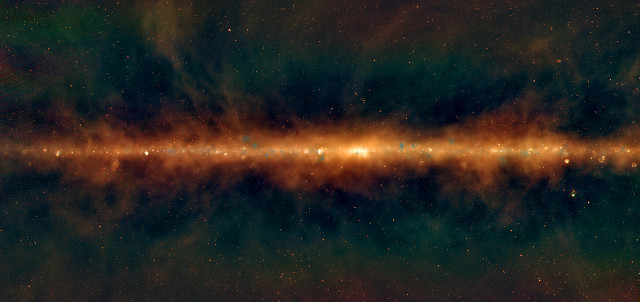
The center of the Milky Way seen in detail by the MWA radio telescope

Three articles published in the journal “Publications of the Astronomical Society of Australia (PASA)” report some results of the GaLactic and Extragalactic All-sky MWA (GLEAM) survey. A team of researchers created some images obtained thanks to the Murchison Widefield Array (MWA) radio telescope showing the center of the Milky Way. Thanks to the low-frequency radio emissions detected, it was possible to generate an image that reproduces both the larger structures and the details. This means that it was possible to obtain an overall image and images of individual objects such as 27 supernova remnants.

The afterglow of GRB 190114C observed by Hubble (Image NASA, ESA, and V. Acciari et al. 2019)

Three articles published in the journal “Nature” report different aspects of the study of a gamma-ray burst cataloged as GRB 190114C which was observed at many frequencies in what’s called multiband observation. Many scientists, particularly the ones from the MAGIC Collaboration, combined observations made using space and ground-based telescopes to study the gamma-ray burst with the greatest energy ever observed. In fact, photons were detected with an energy of the order of the teraelectronvolt, a level theorized for a long time but only now confirmed. A fourth article to be published in the journal “Astronomy and Astrophysics” reports an analysis of the galaxy in which GRB 190114C occurred.

An investigation on multiple star systems shows that many of them host planets

An article published in the journal “Monthly Notices of the Royal Astronomical Society” reports an analysis of data collected by ESA’s Gaia space probe in search for exoplanets in multiple systems. Dr. Markus Mugrauer of the University of Jena, Germany, examined over 1,300 stars hosting exoplanets in a radius of about 1,600 light years from Earth to determine which of them had one or even more companions. The result is that over 200 of them are multiple systems, in one case even a quadruple one, in which the companions are above all red dwarfs but in eight cases there’s a white dwarf as a companion. This is the confirmation that multiple systems with exoplanets are not an exception and that exoplanets can survive the death of one of the stars.

The image of an ancient galaxy multiplied by a gravitational lens

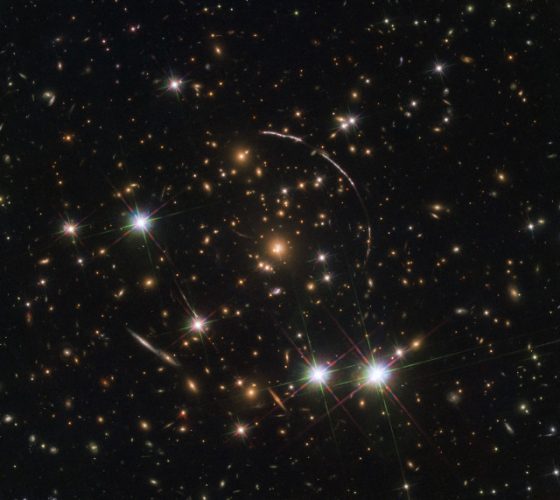
An article published in the journal “Science” reports a study of a galaxy nicknamed Sunburst Arc observed through a gravitational lensing effect that leads to multiplying its image obtaining at least 12 distorted copies in four large arcs. The Hubble Space Telescope detected the light from that galaxy, about 11 billion light years from Earth, thanks to that effect, which also made it between 10 and 30 times brighter. Studying such an ancient galaxy allows to gather information on the early universe and on what’s called the epoch of reionization.

A study of 20 radio galaxies offers new information on the activity of the supermassive black holes at their center

An article published in the journal “Astronomy & Astrophysics” reports a study on the properties of the ionized gas that surrounds supermassive black holes in 20 galaxies selected as a sample. A team of researchers led by Barbara Balmaverde of the Italian National Institute of Astrophysics, Turin, used the MUSE spectrograph mounted on ESO’s VLT in Chile to carry out the MURALES (MUse RAdio Loud Emission line Snapshot) survey, which includes the 20 galaxies studied. These are powerful sources of radio emissions thanks to their active galactic nuclei. The mapping of the ionized gas and its interaction with the relativistic jet produced by central black holes helps to understand the mechanisms of growth and interaction with their host galaxies.