ESO

The Cone Nebula seen by the FORS2 instrument of VLT (Image ESO)

ESO has released an image of the Cone Nebula captured using the FOcal Reducer and low dispersion Spectrograph 2 (FORS2) instrument mounted on the Very Large Telescope (VLT) as part of the 60th-anniversary celebrations of this astronomical research organization’s creation. The convention to create the European Southern Observatory was signed on October 5, 1962, and led to the construction of state-of-the-art telescopes, also in collaboration with other organizations. 60 years of astronomy are also celebrated with a campaign of observations that among other things captured the image of the Cone Nebula.

The Flame Nebula with the NGC 2023 nebula on the right (Image ESO/Th. Stanke)

An article accepted for publication in the journal “Astronomy & Astrophysics” reports an overview of the first results of an astronomical survey called ALCOHOLS concerning the Orion Molecular Cloud Complex. For the occasion, ESO released images of the Orion Flame Nebula, one of the star formation areas within that complex. Researchers led by former ESO astronomer Thomas Stanke used the SuperCam instrument mounted on the APEX radio telescope to map the presence of carbon monoxide in that area. Despite its name and what it looks like in the images, the Flame Nebula is very cold, with temperatures generally just a few degrees above absolute zero.

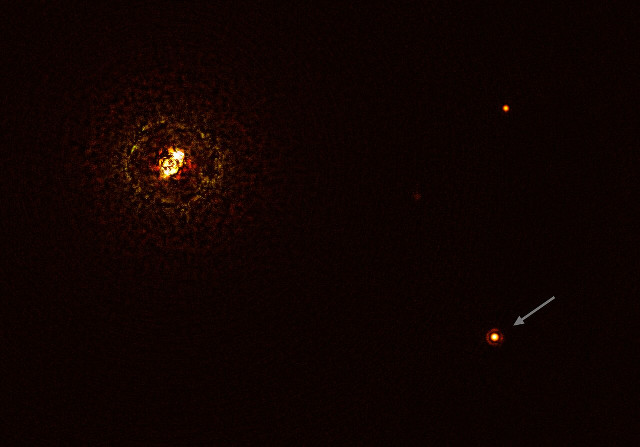
b Centauri's system seen by SPHERE

An article published in the journal “Nature” reports the discovery of a planet in the binary system b Centauri, the most massive in which a planet has been discovered. A team of researchers used ESO’s VLT in Chile to locate the exoplanet cataloged as b Centauri (AB)b or simply b Centauri b photographing it with the SPHERE instrument. It’s a record-breaking planet also because it has a mass estimated at about ten times Jupiter’s, making it one of the most massive known planets, with an orbit that is about one hundred times farther from the two stars than Jupiter’s distance from the Sun. The researchers think that b Centauri b likely formed in another area of its system and then moved due to gravitational interactions.

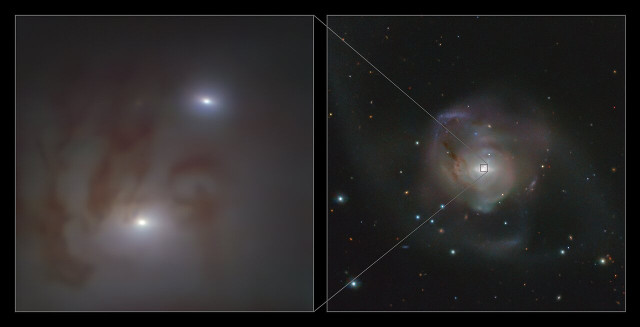
The galaxy NGC 7727 and its pair of supermassive black holes seen by the VLT

An article published in the journal “Astronomy & Astrophysics” reports the detection of a pair of supermassive black holes in the galaxy NGC 7727. A team of researchers used ESO’s VLT to conduct the observations that led to a discovery that broke two records in this field. The two supermassive black holes are the closest pair discovered so far at about 89 million light-years from Earth and are the closest to each other, as their distance was estimated to be around 1,600 light-years.

The galaxies NGC 1300, and NGC 1087, NGC 3627 (top), NGC 4254 and NGC 4303 (bottom)

ESO has published some images created during the PHANGS project using the MUSE instrument on the VLT. These are images of galaxies in the nearby universe in which researchers from the PHANGS project tried to identify stellar nurseries. The aim is to get answers to the questions that still exist about star formation. For this reason, the investigation conducted with the MUSE instrument is a part of a larger project that includes other parallel investigations conducted with the ALMA radio telescope and the Hubble Space Telescope.