Planets

Mars seen on the left in a NASA image based on data from the Mars Orbiter Laser Altimeter (MOLA) and on the right by the Webb Space Telescope's Near-Infrared Camera instrument (NIRCam) at two different infrared wavelengths

The first images of Mars captured by the James Webb Space Telescope on September 5, 2022, offer views of the planet at different infrared wavelengths and some spectroscopies. Webb is in a position where it can see part of the sunlit side of Mars and can provide images and spectra to help complete the detections of space probes, rovers, and other telescopes. The red planet is very close and very bright compared to the normal targets of Webb’s observations, so the exposures used were very short to avoid causing problems to the instruments.

The "Wildcat Ridge" outcrop on Mars (Image NASA/JPL-Caltech/ASU/MSSS)

NASA’s Mars Rover Perseverance collected rock samples in an outcrop that was named “Wildcat Ridge” in the Jezero Crater on Mars. The analyzes show a geological variety that includes a mudstone that contains organic compounds. These results indicate that the rocks in that area are very different from those found on the crater floor, which were igneous rocks that form underground from volcanic magma and on the surface during volcanic activity. These are very interesting samples considering the mission in the design phase that will aim to bring them back to Earth to conduct in-depth analyzes.

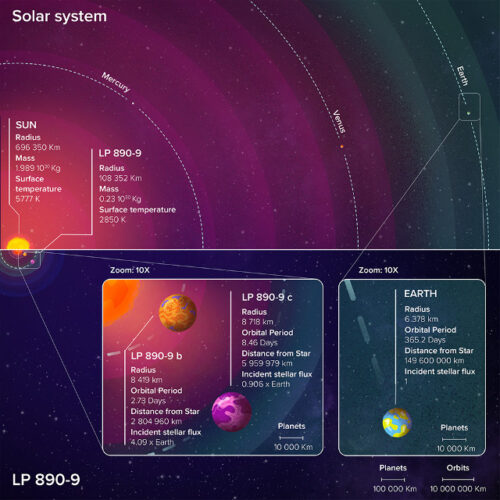
A comparison between the LP 890-9 system and the inner solar system with the characteristics of the stars and their rocky planets

An article published in the journal “Astronomy & Astrophysics” reports the identification of two super-Earths in the system of LP 890-9, a star that is tiny even by red dwarf standards. A team of researchers led by astrophysicist Laetitia Delrez of the Belgian University of Liège examined a candidate identified by the TESS space telescope using the SPECULOOS project Southern Observatory to monitor that system confirming the existence of the exoplanet cataloged LP 890-9b. SPECULOOS found a second exoplanet by observing further transits which was cataloged as LP 890-9c and is in ​its system’s habitable zone. Only TRAPPIST-1 is a smaller star than LP 890-9 among the ones known to have planets.

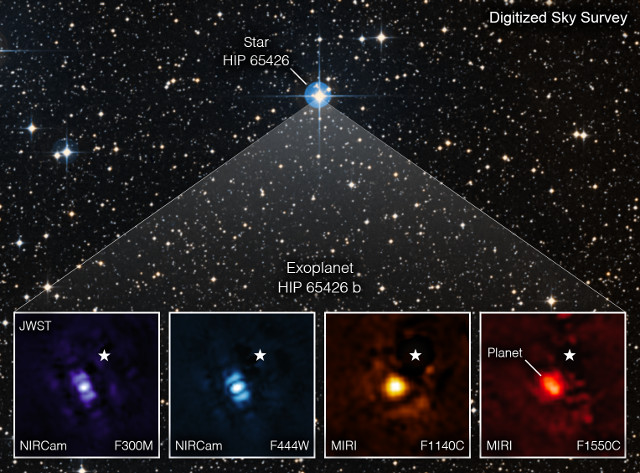
The star HIP 65426 in a Digitalized Sky Survey image and at the bottom, the exoplanet HIP 65426 b seen at different infrared frequencies by the James Webb space telescope's NIRCam and MIRI instruments

An article submitted for peer-review reports the results of the first direct observation of an exoplanet, a super-Jupiter cataloged as HIP 65426 b, by the James Webb Space Telescope. A large international collaboration led by Sasha Hinkley, associate professor of physics and astronomy at the British University of Exeter, conducted observations of this gas giant as part of Webb’s Early Release Science (ERS) program. There are no revolutionary results but the new space telescope observed new details of an already known exoplanet confirming that it can be a valuable instrument to study exoplanets.

Artist's concept of the exoplanet TOI-1452 b (Image courtesy Benoit Gougeon, Université de Montréal)

An article published in “The Astronomical Journal” reports the discovery of a so-called ocean planet cataloged as TOI-1452 b. A team of researchers used observations conducted with NASA’s TESS space telescope and confirmation obtained using follow-up observations conducted with other instruments to locate and subsequently estimate the characteristics of this super-Earth that could be completely covered by an ocean. Its relative proximity to Earth and its position make it an excellent target for further observations, including with the James Webb Space Telescope.