Planets

WISEA J181006.18-101000.5

An article published in “The Astrophysical Journal” reports the discovery of two brown dwarfs thanks to the help of citizen scientists who participated in the Backyard Worlds: Planet 9 program. Cataloged as WISEA J041451.67-585456.7 and WISEA J181006.18-101000.5, those are two objects with masses that fall within the range typical of brown dwarfs but with other characteristics more similar to those of gas giant planets. They could be the first extreme T-type subdwarfs, and resemble ancient exoplanets, with very little iron, having an estimated age of around 10 billion years. Their characteristics make them useful to better understand exoplanets.

Jezero Crater on Mars

Two articles published in the journal “Icarus” report as many studies on Jezero Crater on Mars. Two teams of researchers used data collected by ESA’s Mars Express space probe to reconstruct various parts of the history of Jezero Crater which, with its approximately 49 kilometers in diameter, in the past used to host a lake. It dried out long ago, but left traces such as clay materials that only form in the presence of water. The diversity of minerals is also due to an ancient volcanic activity that affected the entire region. NASA’s Mars 2020 mission, with the Mars Rover Perseverance, will land in Jezero Crater, if all goes well, in February 2021 to also look for possible traces of life, present or past.

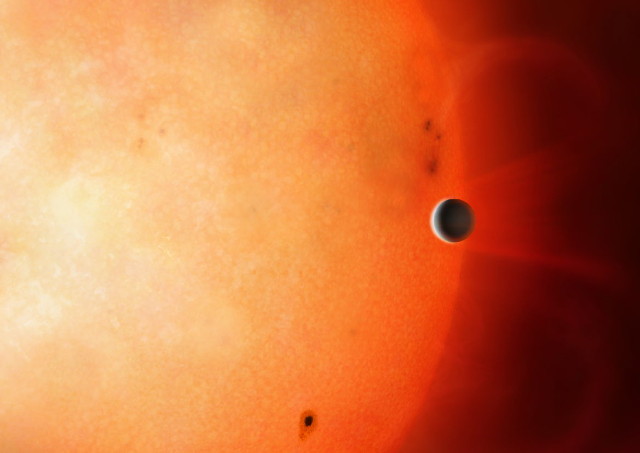
Artist’s impression showing a Neptune-sized planet in the Neptunian Desert (Image courtesy University of Warwick/Mark Garlick)

An article published in the journal “Nature” reports a study on the exoplanet TOI-849b, which appears to be the core of a gas giant stripped of its atmosphere. A team of researchers led by Dr. David Armstrong of the British University of Warwick used data collected by NASA’s TESS space telescope and ESO’s HARPS spectrograph to estimate the characteristics of TOI-849b. The result was that its mass is approximately 40 times the Earth’s with a size similar to Neptune’s, which means that its density is similar to the Earth’s. Its proximity to its star is probably the reason why it doesn’t have an atmosphere, although the possibility remains that it’s a sort of failed gas giant that couldn’t capture gas after the formation of the observed core.

Artist's concept of Kelt-9b and its star in the background (Image NASA's Goddard Space Flight Center/Chris Smith (USRA))

An article published in “The Astronomical Journal” reports a study on the characteristics of the orbit of the exoplanet KELT-9b, an ultra-hot Jupiter very close to its star. A team of researchers led by John Ahlers of the Exoplanets and Stellar Astrophysics Laboratory at NASA’s Goddard Space Flight Center used data collected by NASA’s TESS space telescope to create a model of the interaction between star and exoplanet that allowed to understand better the peculiar characteristics of the star and the extreme ones of KELT-9b. For example, it turned out that the star spins so fast that its poles are flattened making them hotter, and the exoplanet orbits around those poles with the consequence that it has two summers when it passes over them while it has two winters when it passes over the star’s equator.

HBC 672 seen by Hubble (Image NASA, ESA, and STScI)

An article published in “The Astrophysical Journal” reports multi-epoch observations conducted with the Hubble Space Telescope of the star HBC 672 and the movement of the shadow projected by its protoplanetary disk onto an interstellar cloud. A team of researchers led by Klaus Pontoppidan of the Space Telescope Science Institute (STScI) compared the positions of the shadow over 13 months, noting its movement, which has a visual effect similar to a flapping of wings as its shape reminds of that to the point that the star and its protoplanetary disk have been nicknamed Bat Shadow. It could be a planet that is forming and warping the disk.